
The Abandoned Cart Email: Timing, Structure and the Numbers Worth Trusting
What the research shows and how to build a three-email sequence
Mailvex · 9 August 2026 · 5 min read
Send the first abandoned cart email within an hour, the second after a day, the third after two or three. The average ecommerce cart abandonment rate is 70.22%, and almost half of those abandonments come down to unexpected extra costs at checkout. Below is what the research shows, how to structure the sequence and which numbers count as normal.
How many carts are actually abandoned
The 70% figure appears in nearly every ecommerce article, and it holds up: Baymard Institute aggregated fifty independent studies and arrived at an average that has barely moved in over a decade.
There is an important caveat usually left out. A substantial share of people who add to cart never intended to buy on that visit: they compare prices, save items for later, treat the cart as a wishlist. An email will not recover someone who was never buying — it works on the ones something stopped.
Device matters separately. Carts are abandoned markedly more often on mobile than on desktop, and that changes the requirements for the email: if most of your abandonments happen on a phone, the email will be read on a phone too.
80.45% versus 68.62%
Dynamic Yield: cart abandonment on mobile versus desktopWhy people abandon: reasons from the research
Baymard breaks down the reasons through shopper surveys. The top entries barely change year to year, and almost all of them are about the checkout process rather than the product or the price.
- 48% — unexpected extra costs: shipping, taxes, fees
- 19% — being required to create an account before buying
- 18% — a checkout that is too long or complicated
- the rest — security doubts, slow delivery, missing payment method
The practical conclusion: if someone left because of a shipping surcharge, a "you forgot something" reminder will not bring them back. What brings them back is an email that removes the specific objection — showing the final total, offering free shipping or explaining the returns policy.
When to send: a three-email sequence
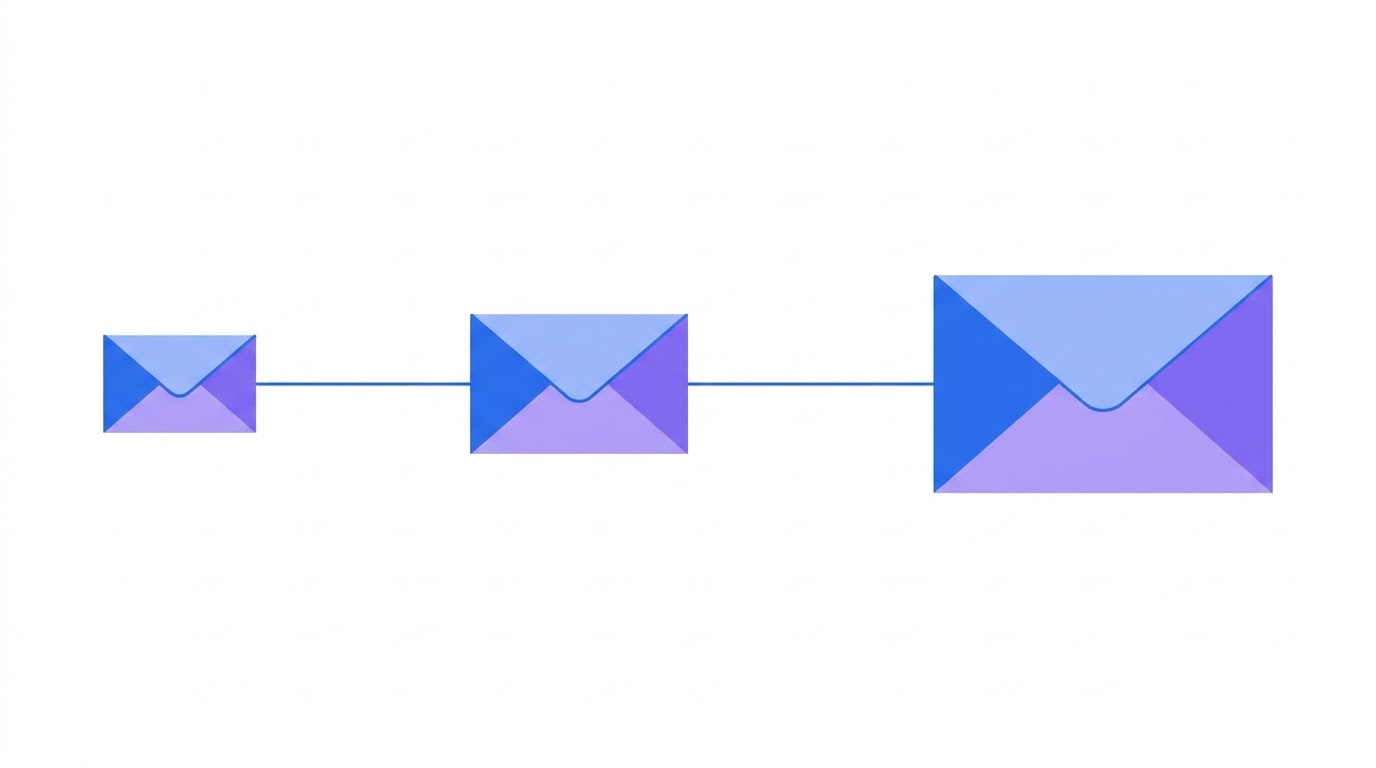
The workable pattern is three emails with different jobs. Not three identical reminders, but three different conversations.
| When | Job | |
|---|---|---|
| First | after 1 hour | remind, show the item, remove a technical objection |
| Second | after 24 hours | remove a substantive objection: shipping, returns, guarantee |
| Third | after 48–72 hours | give a reason to decide: deadline, discount, stock level |
The hour is a guideline, not a law. The logic is that after an hour the person still remembers what they chose but has left buying mode. If your product needs long consideration — expensive electronics, furniture, education — stretch the intervals.
What belongs in the email
- an image of the actual product, not a generic cart illustration
- the name, price and variant details of what was selected
- the final total including shipping, where it is known
- one prominent button leading straight back to the cart
- shipping and returns terms in two lines
- a way to get in touch if there is a question
The product block is the key element. An email showing the exact item someone chose works fundamentally differently from a generic reminder. If there were several items, show two or three rather than the entire list.
What does not belong
- a discount in the very first email — you train people to abandon carts for a coupon
- a countdown timer in every email of the sequence — the device loses its force
- an accusatory tone such as "you forgot" — nobody forgot, they changed their mind
- several competing calls to action
The discount deserves a separate note. Offer it immediately and a share of your customers will quickly learn to abandon carts deliberately. It is wiser to hold it back for the third email, and only for those who ignored the first two.
Which numbers to measure against
It helps to know what counts as normal here. Klaviyo data puts cart recovery through email in the low single digits — and that is a normal result, not a sign of poor work.
around 3.33%
Klaviyo: average cart recovery rate through email
And a separate warning about open rates. With mail privacy protection on Apple devices, opens are registered automatically even when the email was never read. Published open rates therefore differ several-fold between vendors, and the metric can no longer serve as your primary measure. Look at clicks and revenue instead.
How to build one
The Mailvex library includes ready abandoned cart templates for different industries: online stores, fashion, real estate, education, food delivery. Each already contains a product block, a return-to-cart button and a shipping terms block — you only fill in your own data.
Your brand kit applies to the whole sequence at once, so the three emails read as one series rather than three different senders.
Start from a ready abandoned cart template.
Browse the collectionFrequently asked questions
How many emails should the sequence have?
Three is the working standard. A fourth and beyond return progressively less and raise the risk of spam complaints. If three emails did not work, the problem is usually an unaddressed objection rather than the count.
Does an abandoned cart email need a discount?
Not in the first one. A discount up front teaches customers to abandon carts deliberately. Hold it for the third email and only for those who ignored the previous ones.
What counts as a good result?
Recovering a low single-digit percentage of abandoned carts is a normal outcome for email. Measure clicks and revenue per email rather than open rate, which is distorted by Apple mail privacy protection.